From the Salzman Collection — Nikifor
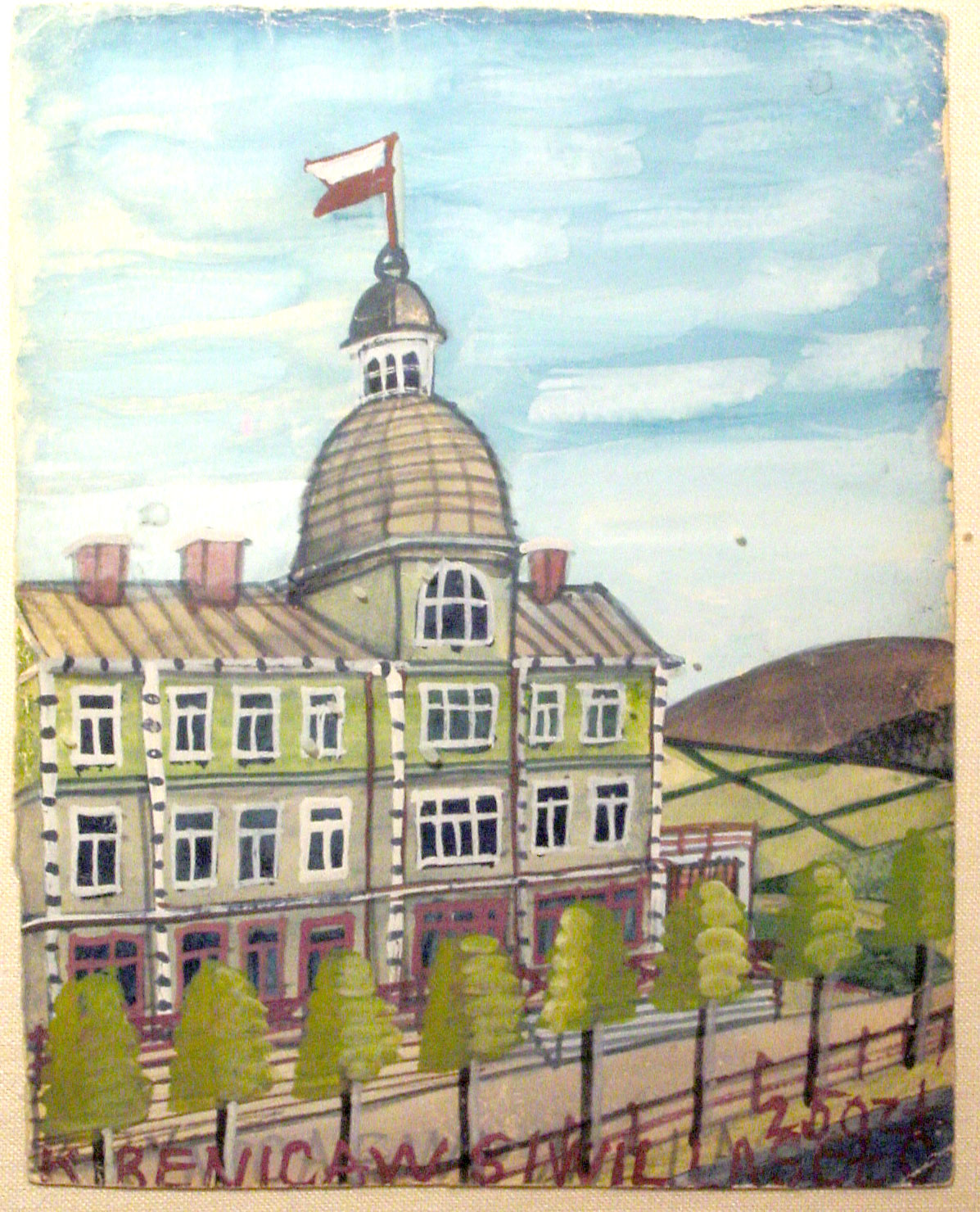
Painting 1

Painting 2
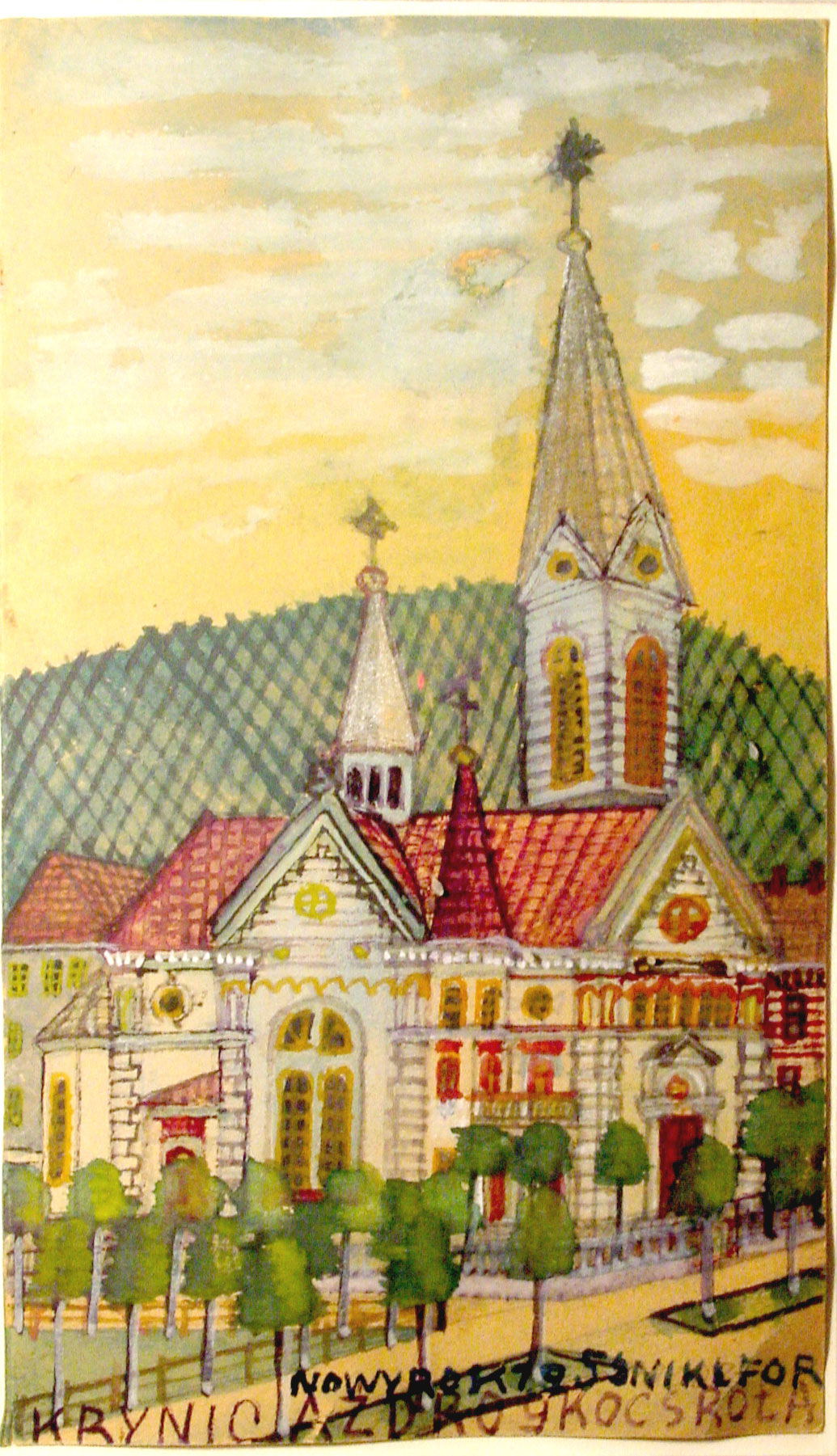
Painting 3
Nikifor's Plea for Support
Holdings
The Salzman Collection holds three gouache paintings on paper, mounted, backed and framed under glass.
The Artist
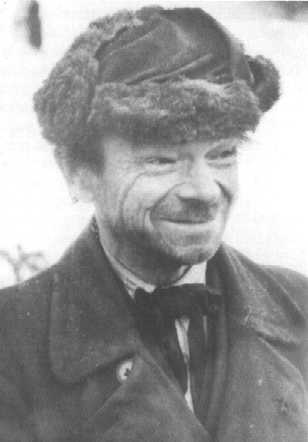
Nikifor
or Nykyfor
(Никифор or Ницифор)
[1]
is the name used by Epifan or Epifaniusz Drowniak (Єпіфан Дровняк),
an outsider
primitivist artist who lived from about
(May 21?) 1895–1968
in what is now a popular ski resort and spa town,
Krynica
[2]
(Криница, AKA Krinica) Wieś, Podkarpackie Wjewództwo
in Malopolskie (Little Poland and specifically,
at one time, the province of
Galicia
or Galicja), Poland in the Kryniczanka Valley carved by
the Poprad river in the Beskid Sadecki mountains,
in the parish of
Nowy Sacz
(Neu Sander, Sants, Sanz, Sonch, Zanz).
Along with Teofil Ociepka, Nikifor is one of the best-known Polish primitivists.
Nikifor was the illegitimate son of Łavdokha or Jewdoka or Eudocia
[3]
Drowniak (Євдока Дровняк, commonly known as Odocha,
Onycha,
or Odoska
),
a possibly deaf-mute
Lemko
(Łemek) beggar and prostitute,
and sometime charwoman at the
Willa Trzy Różea,
a local resort hotel.
She died shortly after childbirth.
The town's Lemkos (eastern Slavs by origin,
claimed by both Ukrainians
and Russians and properly Ruthenians,
Rusyns,
or
Rysnaks,
traditionally a mountain-dwelling people
with distinct Lemkian
dialects of Slavic)
kept the child alive.
Lemkos
were generally poor highlanders,
shepherds and farmers often employed as swineherds in other regions,
but in Krynica able to eke out a living by carrying construction
materials for the villas that wealthy Poles were setting up
in the late XIXth and early XXth century
on northern slopes of the
Carpathian Mountains
surrounding the fashionable spa town or by providing a taxi
service between town and mountains for the summer visitors.
Epifan's severe speech impediment
(supposedly a result of both a hearing impairment
like his mother had and
ankyloglossia
—tongue-tie
),
together with poverty and his debased social condition all
combined to isolate him from any friendships.
His inability to understand what numbers mean suggests
innate intellectual limitations.
Apparently it was at age 13 that Epifan began using pencils to sketch the world around him on any scrap paper he could find. He would give his drawings away to thank people who showed him any kindness. During a hospitalization a physician gave the boy a children' watercolor set.
Epifan then began selling drawings to summer visitors at the famous health resort area, who purchased souvenirs or extended charity.
He would ask a wildly exhorbitant price for a picture,
then happily accept a roll or piece of bread instead.
He much preferred receiving coins over paper money.
With his cash he obtained new watercolor sets,
that he carried in a treasure
chest.
Sometimes this chest also served as bed and bedroom for the young man.
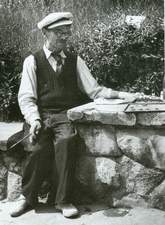
He became a familiar figure about town, setting up his box of materials on a bench or low wall, often by the Willa Patria spa building, licking his brush and creating what to many seemed unrealistic, oddly-colored and sometimes unrecognizable renditions of churches and other public buildings. Epifan also made small watercolor portraits of people on request.
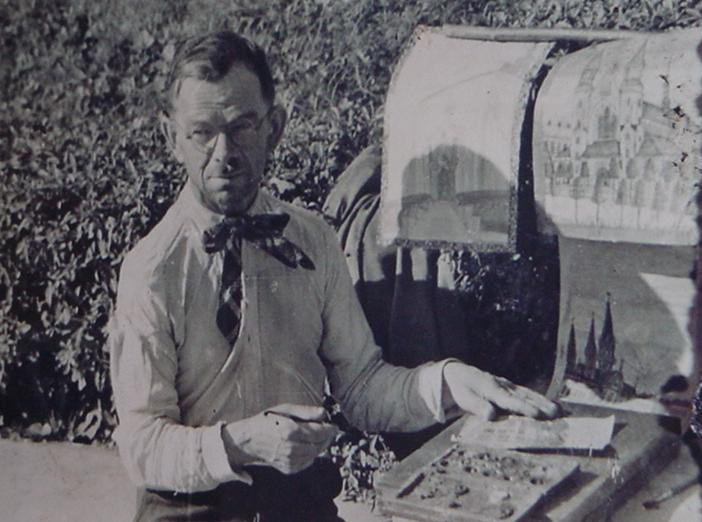
He took himself seriously and always wore a hat and tie, despite his begging compassionate Lemkos for support.
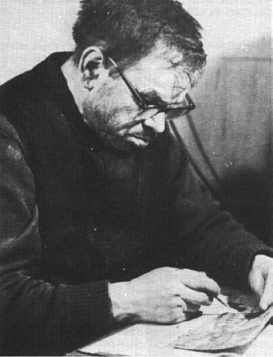
People took to calling him—perhaps
ironically—Nikifor-Matejko
after the celebrated historical painter,
Jan Matejko
(1838–1893),
who had frequented the spa town of Krynica many years before.
Nikifor
itself is a common Slavic name that is variously pronounced in local languages with stress on the first or second syllable.
It may have been the nickname commonly used for Epifan since childhood.
It is speculated that the formal name, Epifan,
unusual for Lemkos and for the area, may have been chosen
by the baptising priest as a way of marking the newborn
baby's illegitimacy.
Interestingly, Antiochus IV Epiphanes
was the name assumed
by the
Seleucid
king in power at the time of the
Jews' Maccabean revolt, who had himself characterized
as the image of God and bearer of victory
,
in Greek "ΘΕΟΥ ΕΠΙΦΑΝΟΥΣ
ΝΙΚΗΦΟΡΟΥ".
[4]
The art world discovered Nikifor in the 1930s
when development of commercial
skiing
was making Krynica a year-round vacation area.
Many prominent artists praised his work,
and foreign exhibitions were arranged.
Despite the vogue his productions acquired, Nikifor's
lifestyle was little affected except
that he began to use guache and wax crayons
for his drawings and would stamp them NIKIFOR-MALARZ
or NIKIFOR ARTYSTA
(painter or artist).
Many of the letters he drew on his paintings seem meaningless
and may have been intended to hide his illiteracy.
Nikifor clung to the
Uniate
religion of the Lemkos, at odds with the Roman Catholicism
of the dominant Polish majority.
He sometimes painted himself as an elegant and respected figure
and seemed particularly interested in drawing church buildings.
His paintings, even of buildings, had qualities of local iconic art:
gravity, stability, timelessness, lack of motion,
bilateral symmetry, green background.
He attempted few traditional biblical scenes.
He would travel by train as far as Kraków,
but showed the great city's gothic,
baroque and renaissance buildings as if they had been constructed
in the style of the wooden structures of Krynica.
Nikifor depicted local railway stations and buildings
that did not exist,
often conflating what he saw in several locations
or inventing elements of structure.
Andrzej Osęka's
critique
describes Nikifor's outsider's view of the world
and the admiring, ceremonial aesthetic style he adopted.
Nikifor's growing renoun enabled him, just once, to leave
Poland for a vacation in Bulgaria.
For this, he acquired a passport as Nikifor Krynicki
(Nikifor of Krynica).
The Polish government made the name official in 1962.
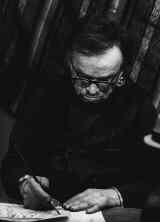
The turmoil of World War II obscured Nikifor's fame and he was largely forgotten for a time. Nikifor himself seemed detached from the events around him, his world being his paintings. Nikifor's work does not seem to reflect the escalating persecution of the Lemkos that occurred over his lifetime, with many intellectuals perishing in Austrian concentration camps in connection with World War I, a short-lived nationalist movement and episodes of "ethnic cleansing" that eventually killed all Jews and most Roma in the area and moved all the Lemkos out. Even when every Lemko in Krynica had been forcibly resettled to Western Poland by the Soviet government's Operation “Vistula” (Akcja “Wisła”) in 1947, Nikifor had soon returned on foot from Szczecin in northern Poland, alone except for his watercolors of seaports and ships. The local townspeople successfully petitioned for this one innocuous Lemko to be allowed to remain.
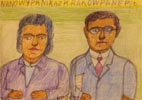
and Andrzej Banach.
The tuberculosis that had plagued Nikifor for years seems to have progressed. He was taken into the home of Ella and Andrzej Banach (Банах), art scholars who made many photographs of the artist and compiled a book about him. They were away on vacation when Nikifor died in a convalescence home in Folusz (Фолюша), Jasno, Poland on October 10, 1968.
Most of Nikifor's tens of thousands of sketches and paintings
have been lost,
many discarded into the trash before he was discovered
.
Efforts to find any Nikifor paintings that might have been put away
and forgotten in Krynica have been futile.
Most Nikifor paintings are now scattered about Europe and
the United States.
The collection of the Muzeum Okręgowe in Nowy Sącz was begun in 1949
and now contains over 1,000 works, many of them at the associated
Nikifor Museum
in Krynica.
A few other museums maintain collections of Nikifor's works
and there have been several exhibits in various countries.
On July 13, 1998 the Polish government issued four
postage stamps
with Nikifor illustrations.
Print References
- Aleksandr, Jackowski: "Notatki o Nikiforze." Polska Sztuka Ludowa number 3-4, pages 227-236, 1985.
- Banach, Andrzej: Nikifor Mistrz z Krynicy. Kraków: Wydawnictwo Literackie, 1957.
- Banach, Andrzej: Pamiątka z Krynicy. Kraków: Wydawnictwo Literackie, 1959. Getty Research Institute Library Catalog: ND699.N48 B3.
- Banach, Andrzej: Nikifor. Arkady, 1984.
- Banach, Andrzej: "Nikifor." in Polsky Słownik Biograficzny, Arkady, 1998, volume XXII, page 96.
- Banach, Ella, & Banach, Andrzej: Historia o Nikiforze [The Story of Nikifor]. Kraków: Wydawnictwo Literackie, 2004 (1966). Getty Research Institute Library Catalog: 90-B9838.
- Bihalji-Merin, Oto: Masters of Naive Art: A History and Worldwide Survey. Russell M. Stockman, trans. New York: McGraw-Hill Book Company, 1971. SBN: 07-005257-3. Getty Research Institute Library Catalog: N7432.5.P7 B513.
- Bihalji-Merin, Oto: Das naive Bild der Welt. Cologne: M. DuMont, pages 146-147, 1959. Getty Research Institute Library Catalog: 90-B30210. Reissued as Modern Primitives: Masters of Naive Painting. New York: Harry N. Abrams, Inc., 1961.
- Bihalji-Merin, Oto & Tomasevic, Nebojsa-Bato: World Encyclopedia of Naive Art: a hundred years of naive art. London: Frederick Muller Ltd., 1984. (English, translated from Serbo-Croatian.) Pages 453-454. Getty Research Institute Library Catalog: N7432.5.P7 W92. Reissued Scranton: Scala/P. Wilson, 1988.
- Duc', Olena:
Nykyfor Drovnjak - Famous Lemko artist.
Carpatho-Rusyn American volume 9, number 2, 1987, retrieved 5 March 2003 from http://www.carpatho-rusyn.org/lemkos/nykyfor.htm . - Gałcziński, Konstanty Ildefons: "Dramat w tunelu." Przkróroj, 1947.
- Madeyski, Jerzy: Nikifor Krynicki. 12 reprodukcji [Tekst: Jan Madeyski]. Kraków, Wydawnictwo artystyczno-graficzne, 1970. 12 color plates. Getty Research Institute Library Catalog: 90-B12048.
- Monroe, Gary: "The Artist Formally Known as Nikifor." Raw Vision s #62, Spring, 2008, pp. 44-47.
- Ostoja-Zagorski, Janusz: Nikifor. 2000, 142 pages, $49.00, ISBN: 8387730181 (hard cover), available via the Polonia Bookstore.
- Petullo, Anthony J. Self-taught and Outsider Art: The Anthony Petullo Collection.
Introduction by
- Slaboshpytszkyi, Mykhailo: Todosz Oszmachka; Literaturnyi Profil: Nykyfor Drovniak iz krysnytsi. Vyd-vo RADA.
- Sydor, Oleh: "Nykyfor-Epyfanii Drovniak: vidkryttia i vidryvachi." Pamiatky Ukraпny (Kiev), number 110, pages 159-161, 1995.s
- Szczepanek, Tadeusz: "Z badań nad twórczośćią Nikifora." Polska Stuka Ludowa number 4, pages 221-242, 1974.
- Szczepanski, Jan Jósef: "Biskup jedzie przez morze." Twórczość number 6, 1972.
- Szczyrbuła, Maciej: "Jeszcze o Nikiforze. Fakty, domysły o legendy."
number 1, 1990. - Wisłocki, Seweryn: "Prczyczynek do biografil Nikifora Drowniaka, nazwanego 'Krynikim'." Polska Sztuka Ludowa numbers 3-4, pages 219-226, 1985.
- Wolanin, Zbigniew: Nikifor. Forward by Andrzej Osekaso. Olszanica, 2000.
- Wolf, Jerzy: "Malarze naiwnego realizmu w Polsce–Nikifor." Arkady, number 3, 1938.
- Zagyrański, Tadeusz: Nikifor: bibliografia w 100-lecie urodzin Nikifora. Warszawa, 1995.
- Zanozinski, Jerzy: "Nikifor i naiwni." Polska Number 11, 1967.
Additional bibliographic references are shown at http://www.lemko.org/lemko/nikifor/nik3.html
Exhibition Catalogs
- [Anonymous]: Nikifor (catalog). Commentary by Zbigniew Wolanin, introduction by Andrzej Osęka. (Polish, with full English translation by Teresa Bałuk-Ulewiczowa.) Wydawnictwo BOSZ. ISBN: 83-87730-18-1.
- Galerie Wolfgang Ketterer, München, 1969 (Lagerkatalog 61). Getty Research Institute Library Catalog: N6999.N584 G13.
- "Zachęta", Warszawa, Poland, June 1967. Warszawa: Centralne Biuro Wystaw Artystycznych, 1967. Getty Research Institute Library Catalog: ND2035.P63 N54.
- Galerie Elke und Werner Zimmer, Düsseldorf, Germany, February 26–March 17, 1984. Getty Research Institute Library Catalog: 88-B30422.
Cinematic References to Nikifor
- Łomnicki, Jan (director): "Mistrz Nikifor" (Made for television documentary, 6 minutes) after the story by Ella Banach. 1956.
- Krause, Krzysztof (director) "Mój Nikifor" (Biopic, 97 minutes) award-winning film depicting the final 8 years of the artist's life (Polish). 2004.
Websites Referencing Nikifor
- http://region.halicz.pl/person/nikifor.html
- http://wiem.onet.pl/wiem/00307a.html
- http://www.bosz.com.pl/k-nikifor.html
- http://www.carpatho-rusyn.org/
- http://www.fineprintsart.com/modern.php
- http://www.gseart.com/artists.asp?ArtistID=87
- http://www.hilt-art.ch/Kuenstler-Lex/matejko_nikifor.htm
- http://www.hmnu.org/postav-en.html and http://www.hmnu.org/postav.html
- http://www.lemko.org/lemko/nikifor/index.html
- http://www.lemko.org/lemko/nikifor/stef01.html
- http://www.merlin.com.pl/sklep/sklep/strona.glowna?str=fis134278&skad=uzkmucpmny
- http://www.opoka.org.pl/zycie_kosciola/kultura/nikifor.html
- http://www.ot-art.nl/Nikifor.htm
- http://www.outsiderart.co.uk/nikifor.htm
- http://www.pinet.pl/enc.php/e09/bN/a1461 \
- http://www.poczta-polska.pl/znackzki/archiwum/a1998_3.htm
- http://www.petulloartcollection.org/the_collection/about_the_artists/artist.cfm?a_id=44
- Portikus October 2000 exhibition
- http://www.ryneksztuki.lodz.pl/images/82aukcja/28-Nikifor.jpg
- http://www.tarnow.kana.pl/wsd/gazety/gosc/archiwum/260498/art10.htm
- http://www.tarnow.kana.pl/wsd/gazety/gosc/archiwum/260498/art10.htm
- http://www.warsawvoice.pl/v541/Buzz06.html
- http://wysylkowa.pl/ks64596.html
- http://zafryki/art.pl/kol/text2e.html
- http://www.wsipnet.pl/oip/historia_3/uczen/rozdzial_5u/zadanie_zi1b.htm
- http://users.iptelecom.net.ua/~keytoart/p/nikifor.htm
Museums, Galleries and Collections
Current and Recent Locations of Works
- Muzeum Nikifora, Krynica, Poland.
- Muzeum Okręgowe w Nowym Sączu (Nowy Sacz Art Museum), Poland (formerly the Great Synagogue, constructed in 1746) includes the Muzeum Nikifora w Krynicy.
- Państwowe Muzeum Etnograficzne, Warsaw, Poland.
- Muzeum Etnograficzne, Kraków, Poland.
- Muzeum Etnograficzne, Tarnów, Poland (perhaps formerly the Muzeum Diecezjalne w Tarnowie?).
- Muzeum Narodowe, Poznań, Poland.
- Museum Charlotte Zander, Schloß Bönnigheim, Bönnigheim, Stuttgart, Baden-Württemberg, Germany (the world's largest collection of outsider art).
- Gallerie St. Etienne; 24 W 57th Street; New York, NY 10019-3963; USA; +1/212/245-6734; jkallir@gseart.com
- Anthony Petullo Collection of Self-Taught and Outsider Art.
- The Ukrainian Museum; 222 E 6th Street; New York, NY 10003; USA; +1/212/228-0110; info@ukrainianmuseum.org
- Le Musée de Louvain-la-Neuve; Louvain-la-Neuve; Brabant; Wallonia; Belgium.
- Städische Kunsthalle Recklinghausen; Recklinghausen; Münster district; North Rhine-Westphalia; Germany.
- Galeria Sztuki, Gorlice, Malopolskie Wjewództwo, Poland.
- Galerie Hamer; Leliegracht 38; 1015 DH Amsterdam; The Netherlands; +31/20/6267394; +31/20/6267394 fax; galeriehamer@hetnet.nl
- Muzeum Pomorza Środkowego w Słupsku, Słupsk, Pornorskie Wjewództwo, Poland.
- Muzeum Łemkivskoj Kul'tury v Zyndranovi (Museum of Lemko Culture); Zyndranova; Krosno; Podkarpackie Wjewództwo; Poland.
- International Morgan Art Gallery; 5350 N. Milwaukee Avenue; Chicago, IL 60630; +1/773/631-0680; 1/773/631-8804 fax; info@morganartgallery.com
- Galerie Zimmer; Oberbilker Allee 27; 4 Düsseldorf 1, Germany; +49/211-332919
- Wasserwerk.Galerie Lange; Wahnbachtalstraße 17; D-53721 Siegburg, Germany; +49/22/41-59-1234; info@galerie-lange.de
- Galerie Bonheur; 10046 Conway Road; St. Louis, MO; USA; +1/314/993-9851; gbonheur@aol.com
- Henry Boxer Gallery; Richmond; Surrey; UK; +44/20/8 948 1633
- Gallerie Hell; Arcisstraße 58; 80799 München; Germany; +49/89/22 66 95; +49/89/29 12 78 fax; info@galerie-hell.de
- Moderna Museet; Slupskjulsvägen 7-9; Stockholm (Skeppsholmen); Sweden; +46/8/5195 5200; +46/8/5195 5210 fax; info@modernamuseet.se
Other Private Collections (possibly not current)
- dr Andrzej Banach, Kraków
- Andrzej Ciechomski, Warszawa
- prof. Jan Cybis, Warszawa
- dr Tadeusz Frąckowiak, Poznań
- Natalia Gałczyńctka, Warszawa
- Alfons Karny, Warszawa
- Władysław Kosterski, Kielce
- doc. Ludwik Maciąg, Warszawa
- dr Jan Mycielski, Kraków
- prof. Janina i Kazimierz Niowie, Warszawa
- red. Janusz Roszko, Kraków
- prof. Hanna Rudzka-Cybisowa, Kraków
- Ewa Sidor, Warszawa
- ks. doc. dr Władysław Smoleń, Lublin
- Ferdynand Solowski, Kraków
- Gizela Szancerowa, Warszawa
- Stanisław Szenic, Warszawa
- doc. Bogusław Szwacz, Warszawa
- prof. Miecysław Wejman, Kraków
- Aleksander Winnicki, Warszawa
- Janina Włodarska, Warszawa
- Marian Włosiński, Krynica
- doc. dr Jerzy Zanoziński, Warzawa
Contact
For information, contact Myron L. Pulier at pulierml@rutgers.edu
Notes
(Click on title to return to text.)
- Никифор. Although Polish uses the Roman alphabet, Ukrainian and Russian use Cyrillic characters. Lemko is a dialect of Carpatho-Rusyn, which has no standard orthography, necessitating transliteration. Much of the written material about Nikifor is in Polish, Lemko, Ukrainian or Russian. Place names and official records relevant to Nikifor are in Polish, but are presented here in other languages where possible.
-
Polish pronunciation of
C
. The Polish C is pronounced like English TS, but CZ is pronounced like English CH as in cheese. -
Polish pronunciation of
Ł
,J
, andW
. The Polish Ł is pronounced like English W. The Polish J is pronounced like English Y as inyes
. The Polish W is pronounced like English V. Thus Łavdoka and Jewdoka sound more or less the same. - Epiphan Nikifor. A coin with such an inscription is shown HERE.